Cockroach milk research earns 2026 Ig Nobel Prize in Chemistry
09-03-2026
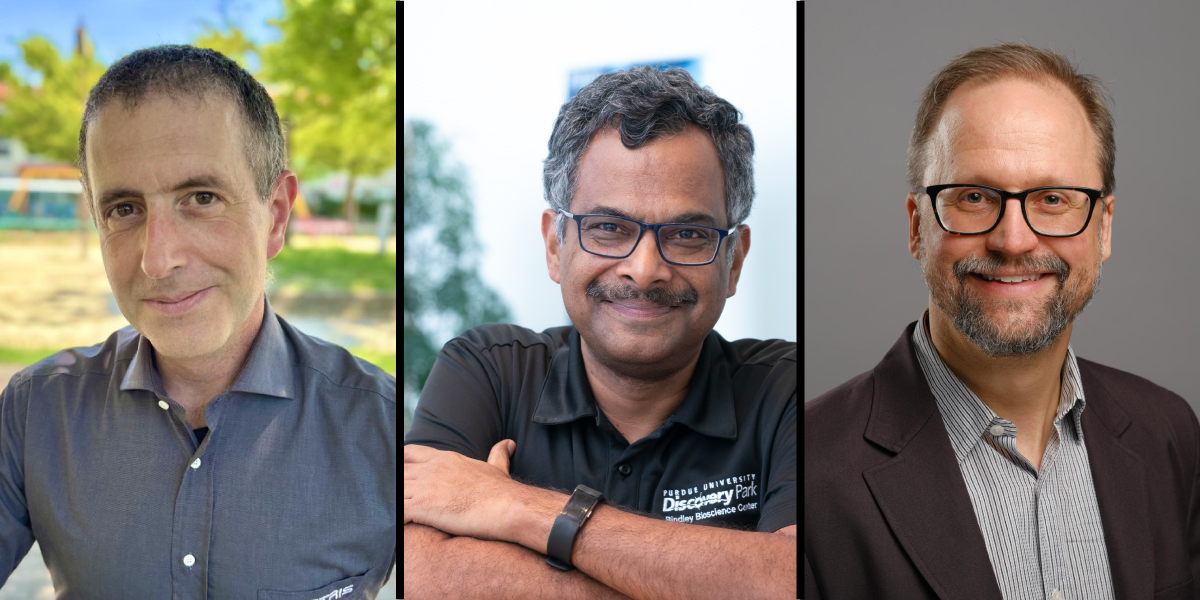
Sometimes the most unexpected scientific discoveries can lead to the most memorable stories.
Ramaswamy Subramanian, a professor in Purdue University’s Department of Biological Sciences; Leonard “Leo” Chavas, structural biologist and general manager and representative director of DECTRIS Japan; and Nathan Coussens, director of the In Vitro Evaluation and Molecular Pharmacology Laboratories at the Frederick National Laboratory for Cancer Research, received the 2026 Ig Nobel Prize in Chemistry for their research into how a species of cockroach nourishes its developing embryos.
The Ig Nobel Prizes, presented annually by Improbable Research, recognize scientific achievements that make people laugh and then think. Winners are selected by the Ig Nobel Board of Governors from nominations submitted by researchers and others around the world. The awards celebrate research that is unusual or surprising while still representing genuine scientific inquiry.
The research, published in 2016 in the International Union of Crystallography Journal (IUCrJ), used structural biology techniques to examine protein crystals formed from milk produced by the viviparous cockroach Diploptera punctata. The team determined the structure of the crystals at atomic resolution, revealing how they serve as a highly concentrated source of nutrition for developing embryos.
Determining the structure required advanced X-ray macromolecular crystallography. By capturing precise diffraction patterns from the tiny in vivo protein crystals, the research demonstrated the crucial role that high-performance detection technology plays in tackling complex and unconventional biological samples.
The research revealed that the crystals are made up of milk proteins that bind lipids and form a tightly packed structure. A single crystal was estimated to contain more than three times the energy of an equivalent mass of dairy milk, providing developing embryos with a concentrated supply of nutrients.
While the subject matter may prompt an initial laugh, Subramanian said the science behind the work is anything but a joke.
“I’m delighted to receive an Ig Nobel Prize because it recognizes something I’ve always believed about science: The most unexpected questions can lead to fascinating discoveries. This research made people laugh because of its unusual subject, but underneath that was a serious effort to understand how nature solves a biological problem. I’m happy that the work has continued to make people curious and think about science in a different way.”
For DECTRIS and Leo Chavas, the recognition highlights how curiosity-driven research and advanced instrumentation intersect to drive scientific understanding.
“What started as a delightfully bizarre inquiry into cockroach milk ended up sparking a major milestone in my career. Witnessing nature engineer such dense, stable protein crystals in vivo inspired me to spend the last decade establishing and running specialized in vivo crystallization platforms across France and Japan to industrialize this fantastic phenomenon. Receiving an Ig Nobel Prize is a fantastic reminder that when high-performance technology meets unbridled curiosity, even the most unconventional biological oddities can open up serious new frontiers in science.”
The award also reflects a collaboration that developed over many years.
When he first saw the specimen, Coussens had a hunch the crystals were something more than the expected waste products. He put the crystals in an X-ray beam and found, to everyone’s surprise, they were proteins. That was 25 years ago, when Coussens was an undergraduate in Subramanian’s lab. It took more than a decade to finally determine the atomic structure, but Coussens’s biophysical studies in the meantime continued to build anticipation and further intrigue the team. Crystals are defined as three-dimensional arrays of identical repeating units, but the crystalline components included many different proteins with different types of sugars attached — so nothing about the crystal contents was “identical.” Throughout the next decade, he continued to collaborate with Subramanian and Chavas and co-authored the paper. The work was an international collaboration, with many students and postdoctoral fellows in the researchers’ laboratories making significant contributions throughout the project.
The study drew interest when it was first published and inspired Coussens’s high school-aged neighbor at the time to eventually earn a Ph.D. in the field of entomology.
“It changed her life,” Coussens said. “The ig Nobel Prize is recognition that our study remains a touchpoint to inspire young learners and to grow their curiosity and love for science.”
The recognition also illustrates how scientific discoveries can continue to open new avenues years after their initial publication. At Purdue, Subramanian is exploring ways to use insights from this unusual protein system in biomolecular design, including work that combines artificial intelligence with protein engineering.
The protein framework identified through the earlier research is exceptionally stable, making it an intriguing starting point for designing proteins with new functions. Rather than engineering proteins for use in insects, the goal is to learn from the unusual properties found in nature and apply those principles to new biomolecular designs.
“This is one of the exciting things about doing science,” Subramanian said. “You start with one question, and years later you realize there are entirely new questions and possibilities that came from that discovery.”
For Subramanian, the recognition is a fitting next chapter for research that has already attracted attention around the world, and a reminder that science can be both rigorous and surprising.
Coussens observed that the cockroach crystal science advanced over time through important contributions from many researchers connected by shared curiosity. The recognition is confirmation that fascinating science inspires and connects people.
For Chavas, trading a lab bench for an executive suite hasn't dampened the spark of pure scientific mischief, proving that even a quest into cockroach milk can earn a permanent spot in the hall of delightful, curiosity-driven science.
About the Department of Biological Sciences at Purdue University
The Department of Biological Sciences is the largest life sciences department at Purdue University. As part of Purdue One Health, we are dedicated to pioneering scientific discoveries and transformative education at the cutting edge of innovation. From molecules to cells, from tissues to organisms, from populations to ecosystems- we bring together multiple perspectives, integrating across biological scales to advance our understanding of life and tackle the world’s most pressing challenges. Learn more at bio.purdue.edu.
DECTRIS Ltd. develops and manufactures state-of-the-art X-ray and electron detection cameras to spark scientific breakthroughs around the world. While photographic cameras capture visible light, DECTRIS cameras count individual X-ray photons and electrons. DECTRIS is the global market leader at synchrotron light sources. Laboratories also achieve high-quality results with our technology. Our detectors played for example a decisive role in the determination of the structures of the coronavirus. Our impact extends to research in the sectors of energy, the environment, and industry, and we offer novel solutions for medical applications. We support researchers everywhere from our offices in Switzerland, Japan and the United States. More at www.dectris.com.
About the Frederick National Laboratory for Cancer Research
The Frederick National Laboratory for Cancer Research is a government-owned, contractor-operated research and development center that provides rapid response to emerging national and global health problems and conducts long-term research on cancer, as well as infectious and other diseases. It is operated by Leidos Biomedical Research, Inc. on behalf of the National Cancer Institute. Located in Frederick, Maryland, the Frederick National Laboratory is the only Federally Funded Research and Development Center devoted exclusively to biomedical research.
Written by: Alisha Willett, Senior Communications Specialist, Ave-Lii Idavain, and Amanda Corbel
Contributors: Rams Subramanian, Leo Chavez, Nathan Coussens