How an unusual partnership between three organisms evolved
11-11-2026
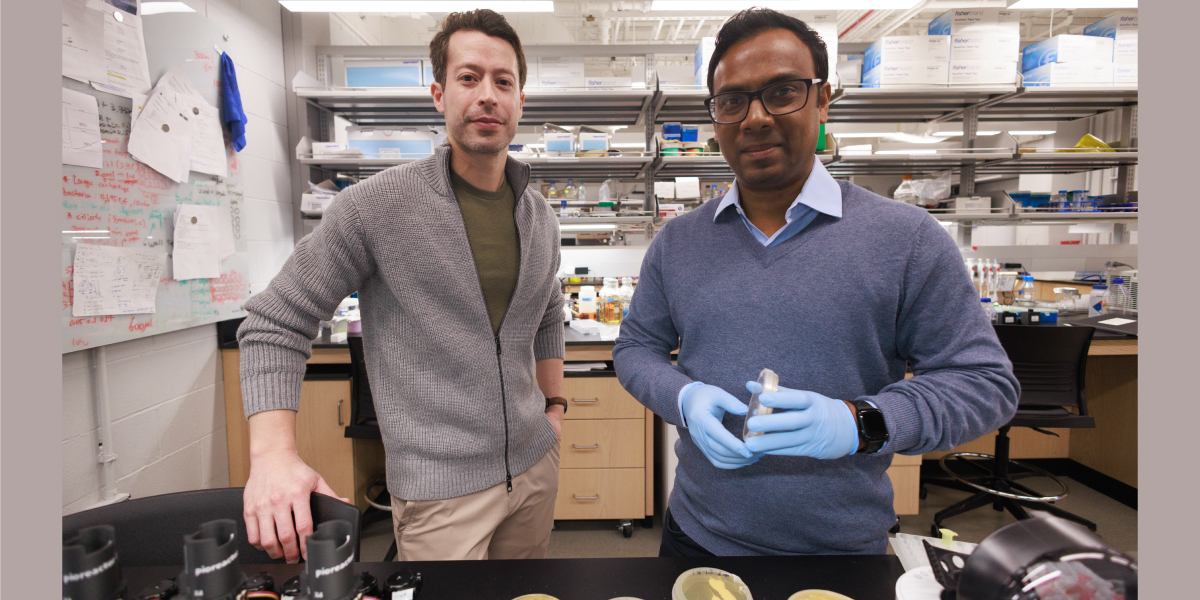
Purdue researcher uncovers clues to how a rare relationship between a microscopic organism, green algae and purple bacteria came to be.
Life on Earth is full of unexpected partnerships. Some organisms live inside others, exchanging resources in ways that help them survive. But how do these relationships begin, especially when the organisms involved have very different ways of making a living?
A new study led by Sergio Muñoz-Gómez, an assistant professor of biological sciences at Purdue University, offers new clues. By studying a microscopic organism that houses both green algae and purple bacteria, the research team reconstructed possible steps that led to this unusual partnership.
The findings, published in The ISME Journal, help explain how organisms with contrasting ways of obtaining energy can come together and evolve as a community.
An unusual combination
The research focuses on Pseudoblepharisma tenue, a single-celled organism called a ciliate that lives in shallow freshwater ponds. Inside its cell, it houses two very different partners: green algae and purple bacteria.
The green algae use sunlight to make food through photosynthesis, releasing oxygen in the process. The purple bacteria also use light to obtain energy, but they do not release oxygen as a byproduct. These bacteria are adapted to environments with little oxygen.
Although partnerships between organisms that consume food and those that use sunlight to make it are found throughout nature, relationships involving purple photosynthetic bacteria are exceptionally rare. P. tenue is particularly remarkable because it brings together two different kinds of photosynthetic partners within a single host.
Understanding how this combination arose could help scientists explain why some partnerships evolve readily while others are uncommon.
Reconstructing an evolutionary history
To investigate the origins of this relationship, Muñoz-Gómez and his colleagues studied newly collected samples of related microscopic organisms from Germany and South Korea. They compared genetic information to determine how the organisms were related and examined their biological characteristics to learn more about how they function.
The expanded sampling revealed several previously unrecognized close relatives of P. tenue. Among them were colorless species that do not have photosynthetic partners, as well as a species that houses green algae and two additional types of bacteria.
These discoveries provided important clues about the sequence of events that may have led to the purple-green partnership.
The researchers propose that the ancestors of these organisms initially lived without photosynthetic partners and were able to survive in environments with little or no oxygen. Green algae likely joined the relationship first. Their presence may have helped establish a community in which organisms exchanged resources and produced conditions that made it possible for purple bacteria to join later.
In other words, the unusual partnership probably did not emerge all at once. Instead, it may have developed through a series of steps, with each new partner changing the environment and creating opportunities for another.
Why these partnerships matter
For Muñoz-Gómez, the study is part of a broader effort to understand how major innovations in cells and new biological partnerships arise over evolutionary time. These changes can allow organisms to occupy new environments and diversify into new forms of life.
The findings also offer a starting point for exploring how organisms with different biological capabilities can cooperate. Understanding the conditions that allow these relationships to develop could eventually help researchers design synthetic partnerships between organisms for useful purposes, such as breaking down waste.
“This system shows us how organisms with very different ways of obtaining energy can come together and cooperate. By understanding how these partnerships evolved, we can learn more about how new biological relationships emerge and, eventually, how we might design similar partnerships to address challenges such as waste degradation”, says Muñoz-Gómez.
The research received support from NASA’s Exobiology Program. Muñoz-Gómez also credits Purdue’s Center for Plant Biology with providing important support for his research.
About the Department of Biological Sciences at Purdue University
The Department of Biological Sciences is the largest life sciences department at Purdue University. As part of Purdue One Health, we are dedicated to pioneering scientific discoveries and transformative education at the cutting edge of innovation. From molecules to cells, from tissues to organisms, from populations to ecosystems- we bring together multiple perspectives, integrating across biological scales to advance our understanding of life and tackle the world’s most pressing challenges. Learn more at bio.purdue.edu.
Written by: Alisha Willett, Senior Communications Specialist, amwillet@purdue.edu
Contributors: Sergio Muñoz-Gómez, samunozg@purdue.edu