A connection that keeps giving: Reid Leonard invests in Purdue's future
11-17-2026
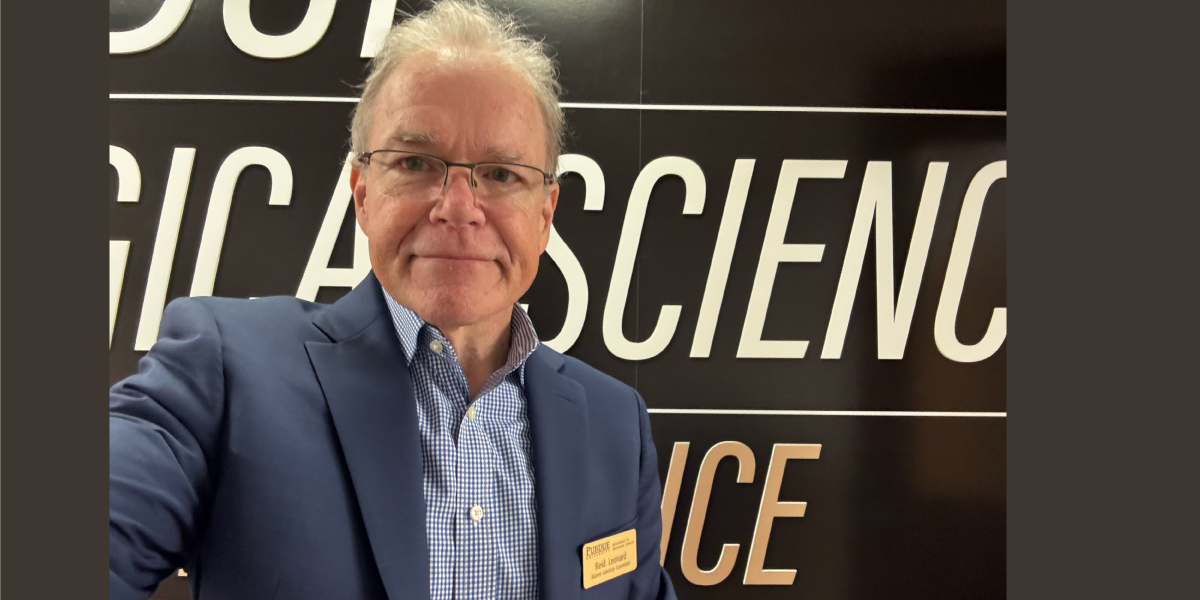
For Reid Leonard, Purdue Biological Sciences has always been about more than the research he conducted as a graduate student. It is where he built the foundation for a career in pharmaceutical research and biotechnology, met his wife, Debbie, and developed a lasting connection to a community he continues to support.
That connection has taken many forms over the years. He has served on the department’s Biological Sciences Advisory Committee (BSAAC), established a scholarship with Debbie to support undergraduate students and remained engaged with the department through several stages of his professional life. For him, giving back is a way to help ensure future students have access to the opportunities that shaped his own career.
Leonard arrived at Purdue in 1981 after earning his undergraduate degree from Brandeis University. He initially was considering a graduate degree program at the veterinary school, but an invitation to present a seminar about his undergraduate research during his campus visit introduced him to the faculty of the Department of Biological Sciences.
He joined the laboratory of Shigehiro Nakajima, where he focused on neuroscience and cellular excitability, including ligand-gated and voltage-gated ion channels. The research gave him access to sophisticated instrumentation that was not commercially available at the time. Purdue’s strengths in engineering made it possible for researchers to develop the tools they needed. Debbie, meanwhile, earned her Ph.D. in the lab of Bill Pak.
After completing their graduate work, the couple moved to California for postdoctoral positions at the California Institute of Technology. That experience helped launch his career in pharmaceutical research.
He joined Merck, where he spent 25 years working in ion channel research and later in External Scientific Affairs. That licensing group, which initially had four members, grew to about 40 during his tenure. As executive director, Leonard helped connect the company with promising research and development opportunities from universities and biotechnology companies.
In 2015, he moved into the biotechnology sector, helping launch companies focused on immuno-oncology. One, Potenza Therapeutics, was acquired by Astellas; another, Werewolf Therapeutics, became a publicly traded company. He retired from his role as chief operating officer in 2023, but has continued to work in biotechnology, including co-founding a new company focused on ion channels with a former Purdue graduate student.
Throughout those career changes, Leonard maintained his involvement with Purdue through BSAAC. His professional experience in pharmaceutical research, biotechnology and venture development gave him different perspectives to share with the department as its needs and opportunities evolved.
But what he values most about serving on the committee is the opportunity to reconnect with the academic community.
“What I get out of it is still what it was the first time I visited,” he said. “It’s the ability to engage with the undergraduate, graduate students and the faculty, to get an appreciation for the amazing quality of the work that goes on here and the quality of the training.”
He also hopes students see the many career paths available to people with a background in biology, including opportunities beyond the traditional academic or laboratory settings.
That commitment to student opportunity also inspired the couple to establish the Scarborough Leonard Scholarship Fund. The undergraduate scholarship gives preference to first-generation students when eligible recipients are available. Both Leonard and Debbie were the first in their families to attend college, making the opportunity to support students navigating a similar path especially meaningful.
“Debbie and I wanted to do something as a couple to support Purdue,” he said.
Although neither was an undergraduate at Purdue, their connection to the university is deeply personal. They met while graduate students on campus, and the relationships and experiences they built there have remained important throughout their lives.
The couple also sees their scholarship as an investment in something larger than an individual student’s education: the value of scientific understanding. They believe the ability to evaluate information, understand evidence and think critically is essential to participating fully in society, particularly in a world shaped by social media and artificial intelligence.
Support for undergraduate and graduate education, as well as faculty research, once seemed like an obvious priority, he said. Today, he believes those commitments need continued support.
“That’s the strongest motivation for us to keep giving,” he said. “We need more people who can appreciate the value of science and evidence-based thinking.”
Leonard sees Purdue’s land-grant mission and commitment to service as central to the university’s identity. He hopes BSAAC can help strengthen the department’s connections with a broader community of alumni, not simply by asking them for support, but by giving them meaningful opportunities to reconnect with the people and exciting work advancing biological sciences today.
He encourages alumni who are interested in staying connected to consider joining the Biological Sciences Advisory Committee and sharing their experiences and perspectives with the department by emailing biology@purdue.edu.
Purdue helped launch Leonard's career, but the relationship has never been one-sided. Through his time, experience and generosity, he and Debbie are helping ensure that future students have access to the same kinds of transformative opportunities.
And that, for Reid Leonard, is reason enough to keep coming back.
About the Department of Biological Sciences at Purdue University
The Department of Biological Sciences is the largest life sciences department at Purdue University. As part of Purdue One Health, we are dedicated to pioneering scientific discoveries and transformative education at the cutting edge of innovation. From molecules to cells, from tissues to organisms, from populations to ecosystems- we bring together multiple perspectives, integrating across biological scales to advance our understanding of life and tackle the world’s most pressing challenges. Learn more at bio.purdue.edu.
Written by: Alisha Willett, Senior Communications Specialist, amwillet@purdue.edu
Contributors: Reid Leonard