From Peer Review to Middle School: Translating Science for Young Readers
01-14-2026
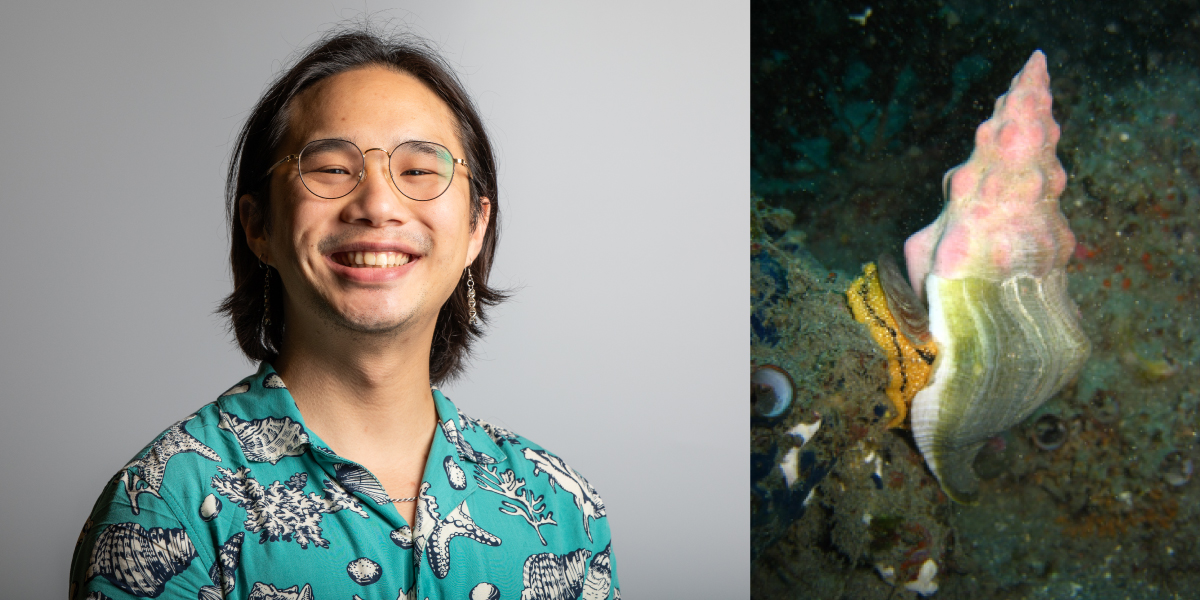
Andy Lee worked with Science Journal for Kids to adapt his research for students — and discovered new ways to think about science communication.
When Purdue University Biological Sciences PhD student Andy Lee saw his first research paper published, he expected the usual academic audience- fellow scientists, reviewers and specialists in his field. What he didn’t expect was to soon be explaining that same research to middle and high school students around the world.
Lee’s study was recently adapted by Science Journal for Kids, a nonprofit organization that translates peer-reviewed research into age-appropriate articles for students and educators. The adaptation, “Why are some sea snails moving north?”, reframes Lee’s original research at a reading level accessible to younger audiences while preserving the accuracy that scientific work demands.
For Lee, the experience was less about simplifying the science and more about learning how to communicate it clearly.
“Working with the editors really made me think about how we explain what we do and why it matters,” Lee said. “You have to be precise, but you also have to make sure the story makes sense to someone who’s encountering these ideas for the first time.”
Science Journal for Kids pairs researchers with professional editors who specialize in science communication. Together, they identify the central question of a study, define unfamiliar terms and remove unnecessary complexity, all without changing the meaning of the findings. Lee described the process as a careful balancing act between clarity and accuracy.
The final product goes beyond a written article. Lee’s adapted study includes a text-to-speech option designed to support students with disabilities, along with classroom-ready teaching materials for educators. Additional resources were developed, including a Spanish-language version (PDF) and a short video highlighting how teachers can use the article in their lessons.
The reach of the adaptation quickly became tangible. Through a partnership with Skype A Scientist- a program that connects classrooms with working scientists- Lee was invited to participate in a live Q&A with students who had read the article. In December, he joined a livestream that drew 83 classrooms from around the world.
Students asked questions about sea snails, climate change and what it’s like to be a scientist. For Lee, the conversation was a reminder that curiosity doesn’t depend on age.
“It was exciting to see how engaged the students were,” he said. “They weren’t intimidated by the science. They just wanted to understand it.”
Lee’s original research examines how Kellet’s whelks, a type of marine snail, are responding to cooler temperatures as their range expands northward. By comparing populations from different regions, his work shows that snails in newly occupied areas are already exhibiting genetic differences linked to cold tolerance. While the study contributes to broader conversations about how ocean species respond to climate change, Lee said the details mattered less during the adaptation process than the bigger picture.
“At its core, the study is about how living things respond when their environment changes,” he said. “That’s something students can connect to, even if they’ve never thought about genetics before.”
Now in the later stages of his doctoral training, Lee studies how marine species evolve in a changing ocean, focusing on genetic adaptation and population connectivity. Communicating that work beyond academic journals, has become an increasingly important part of his development as a scientist.
Experiences like Science Journal for Kids, highlight a growing role for researchers: meeting the public where they are and inviting them into the scientific process.
For Lee, seeing his work spark questions in classrooms across the globe made the effort worthwhile. What began as a technical research paper has become a teaching tool, opening the door for students to engage with real science, and perhaps imagine themselves doing it someday.
About the Department of Biological Sciences at Purdue University
The Department of Biological Sciences is the largest life sciences department at Purdue University. As part of Purdue One Health, we are dedicated to pioneering scientific discoveries and transformative education at the cutting edge of innovation. From molecules to cells, from tissues to organisms, from populations to ecosystems- we bring together multiple perspectives, integrating across biological scales to advance our understanding of life and tackle the world’s most pressing challenges. Learn more at bio.purdue.edu.
Written by: Alisha Willett, Communications Specialist, amwillet@purdue.edu
Contributors: Andy Lee, lee3617@purdue.edu