Connecting Immune Signaling and Reproductive Health
02-17-2026
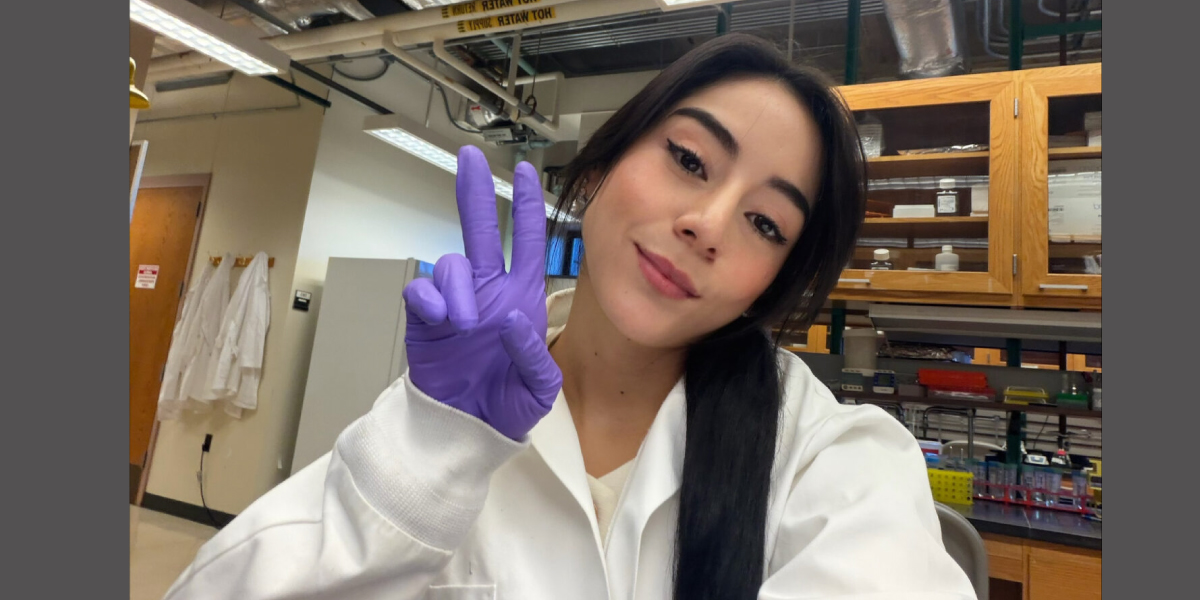
Curiosity often drives scientific discovery in unexpected directions.
For Alejandra Rodriguez, a doctoral candidate in Purdue University’s Department of Biological Sciences, a question that began in immunology has opened a new line of inquiry into women’s reproductive health- and earned her a spot in one of the Graduate School’s most competitive science communication programs.
Rodriguez was selected as a featured scholar for the 2025–26 edition of InnovatED, a publication produced by Purdue’s Office of Graduate and Postdoctoral Studies. Each year, the program selects 10 graduate students and postdoctoral scholars from across Purdue to share their research with a broader audience. Participants also receive science communication coaching and a $500 award.
Being chosen is especially meaningful to Rodriguez because of the story behind the work.
Her research did not begin as her primary project. While studying how gut microbes interact with the immune system, she observed an unexpected change in reproductive traits connected to the absence of a single immune protease- an enzyme that helps regulate immune responses. The finding fell outside the original scope of her study.
“Rather than setting the observation aside, I followed the question,” Rodriguez said.
That moment of curiosity led her to explore how one immune protease may influence reproductive health. Her work now examines whether immune signaling pathways- often studied in the context of infection or inflammation- could also play a role in conditions such as endometriosis and polycystic ovary syndrome, commonly known as PCOS.
“I’m interested in how basic immunology can connect to topics like endometriosis, PCOS, fertility and hormone balance,” she said. “The immune system doesn’t operate in isolation. It helps maintain balance across many biological systems.”
If one component of that system, such as a specific protease, is altered, it may have ripple effects beyond immunity alone. By investigating these connections, Rodriguez aims to better understand how immune signaling intersects with hormone regulation and fertility.
Her adviser, Matthew Olson, said Rodriguez’s approach reflects the kind of scientific thinking that drives discovery.
“Alejandra exemplifies how sharp observational skills, paired with genuine curiosity, drive science forward,” Olson said. “She transformed an early observation into meaningful insights that advance our understanding of immune-uterine interactions and the fundamental biology of the female reproductive tract. She is now integrating emerging literature and uncovering connections between these granzymes and human reproductive tract diseases. This level of initiative, depth of thinking and scientific maturity is everything you hope to see in a graduate student. I am extraordinarily proud of the scientist she is becoming.”
Her selection for InnovatED underscores the importance of communicating research beyond academic journals. Through the program’s coaching and publication process, Rodriguez has translated complex scientific ideas into a story accessible to readers outside her field- sharing how a moment of curiosity can open new directions in research.
About the Department of Biological Sciences at Purdue University
The Department of Biological Sciences is the largest life sciences department at Purdue University. As part of Purdue One Health, we are dedicated to pioneering scientific discoveries and transformative education at the cutting edge of innovation. From molecules to cells, from tissues to organisms, from populations to ecosystems- we bring together multiple perspectives, integrating across biological scales to advance our understanding of life and tackle the world’s most pressing challenges. Learn more at bio.purdue.edu.
Written by: Alisha Willett, Communications Specialist, amwillet@purdue.edu
Contributors: Alejandra Rodriguez, rodri660@purdue.edu