Major NCI Grant Secured to Advance Cancer Research
12-23-2025
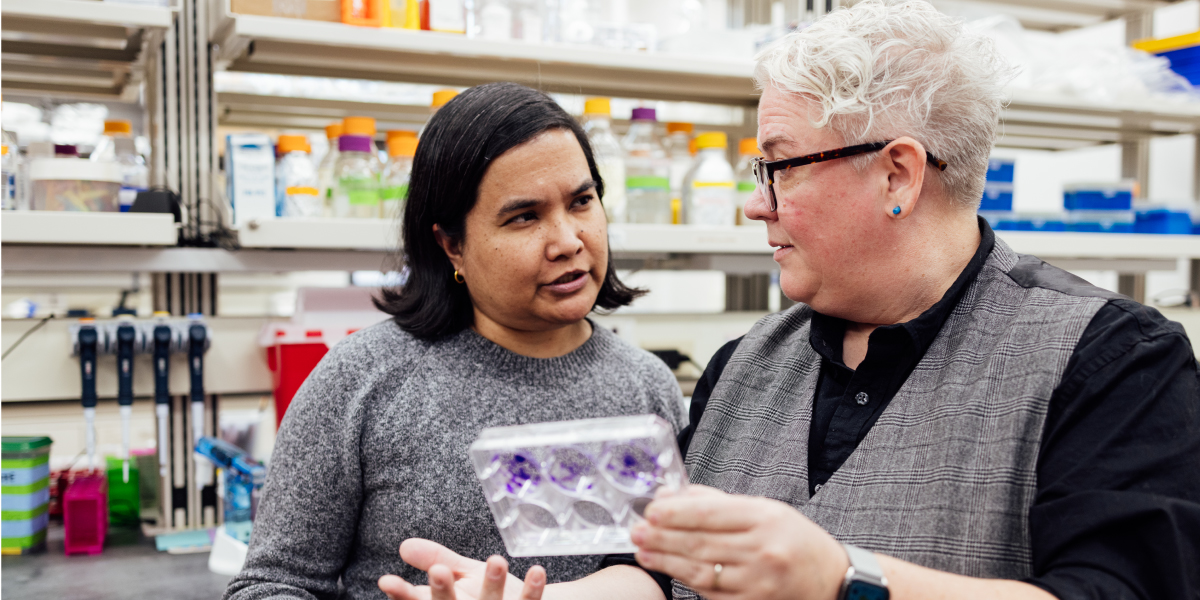
Purdue University’s College of Science is celebrating a significant milestone for cancer research on campus. Brittany Allen-Petersen, assistant professor of biological sciences and a member of the Purdue Institute for Cancer Research, has earned a prestigious five-year R01 grant from the National Cancer Institute. The award, totaling more than $2 million, will expand her lab’s capacity and drive new investigations into how cancer cells survive in challenging environments.
The grant arrives at a pivotal moment for Allen-Petersen’s growing lab. Her proposal earned an exceptional score in a highly competitive cycle, providing long-term stability for her team and momentum for a research direction developed entirely within her group.
“This type of grant allows us to fully pursue the questions that have the potential to make the biggest impact,” Allen-Petersen said during a recent discussion about the project.
Her research centers on how cancer cells adapt to harsh tumor conditions by scavenging nutrients from their surroundings. One such process, macropinocytosis, allows cells to take in material from the environment to fuel their growth. Allen-Petersen’s lab has identified a phosphatase they believe regulates this process. The new grant will allow the team to uncover how that regulation works and why it matters for tumor progression and treatment resistance.
With this support, the lab will establish new experimental models, including advanced mouse models that will become valuable tools for the scientific community. The team will also conduct CRISPR-based screens to identify weaknesses that emerge when the phosphatase’s activity is altered, which may reveal new therapeutic strategies.
A major component of the project is a collaboration with Shalini Low-Nam, assistant professor of chemistry and a fellow member of the Purdue Institute for Cancer Research. Together, their labs will use sophisticated microscopy techniques to observe changes in protein function at extremely small scales, helping illuminate how the phosphatase shapes cancer cell behavior. This interdisciplinary partnership strengthens the project’s scientific reach and reflects the cancer institute’s commitment to collaborative research.
Allen-Petersen emphasized the importance of early support from organizations that helped her build the foundation for this work. Grants from the Pancreatic Cancer Action Network and the American Cancer Society provided essential resources for generating preliminary data, while pilot funding from the Purdue Institute for Cancer Research advanced related manuscripts now under revision.
The R01 award will also allow the Allen-Petersen Lab to grow. Several graduate and undergraduate researchers are already contributing to related projects, and the new funding will support additional trainees and expand the lab’s research capacity.
For Allen-Petersen, the project represents both a scientific opportunity and an important milestone for her young lab. “This direction grew directly out of observations we made here,” she noted. “It’s exciting to see it move forward with the support needed to answer the big questions.”
About the Department of Biological Sciences at Purdue University
The Department of Biological Sciences is the largest life sciences department at Purdue University. As part of Purdue One Health, we are dedicated to pioneering scientific discoveries and transformative education at the cutting edge of innovation. From molecules to cells, from tissues to organisms, from populations to ecosystems- we bring together multiple perspectives, integrating across biological scales to advance our understanding of life and tackle the world’s most pressing challenges. Learn more at bio.purdue.edu.
About Purdue Chemistry
The Tarpo Department of Chemistry is internationally acclaimed for its excellence in chemical education and innovation, boasting two Nobel laureates in organic chemistry, the #1 ranked analytical chemistry program, and a highly successful drug discovery initiative that has generated hundreds of millions of dollars in royalties. chem.purdue.edu
Written by: Alisha Willett, Communications Specialist, amwillet@purdue.edu
Contributors:
- Brittany Allen-Petersen, ballenpe@purdue.edu
- Shalini Low-Nam, slownam@purdue.edu