Breaking Through the Data Stack: Purdue Researchers Uncover a Clearer View of Behavior
12-03-2025
What if understanding behavior were as simple as laying out the pages of a book so you can see the whole story at once?
Neuroscientists increasingly rely on massive digital records of how subjects respond to their surroundings over time, but making sense of those layers can be overwhelming. A new study led by Purdue University shows that sometimes the clearest answer comes from taking a step back- and choosing a simpler path.
In recent years, advances in imaging, tracking and automated recording have allowed researchers to collect behavior data in far more detail than before. These time-series datasets can capture dozens of measurements from many subjects across hundreds or thousands of moments. That complexity contains clues about how the nervous system works, but it also creates a challenge: How do you condense all that information without losing the meaning behind it?
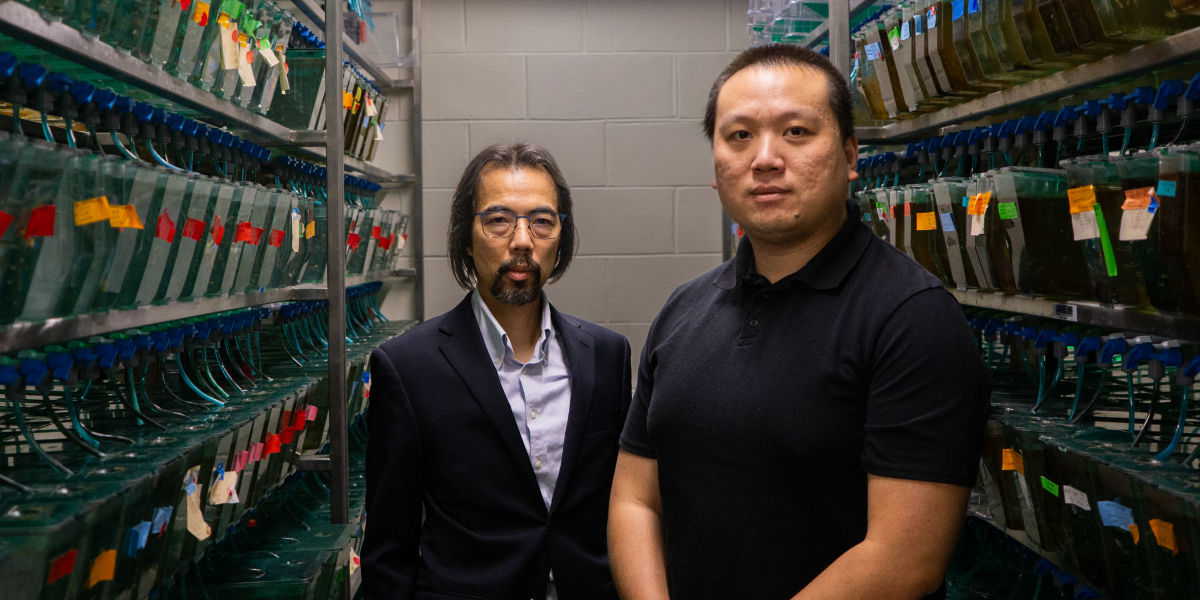
Beichen “BC” Wang, a Ph.D. candidate in Purdue’s Department of Biological Sciences and the study’s first author, said almost every team working in neurobehavioral research faces this problem.
“The data look like a stack of papers,” Wang said in describing the issue. “Traditional tools were built for a single sheet- not a whole book.”
Working with Associate Professor Yuk Fai Leung, Wang investigated whether a straightforward alternative could outperform more established analytical methods. Instead of relying on complex mathematical transformations that can strip away intuitive interpretation, the team tried a simpler technique called matricization. That approach reorganizes a three-dimensional dataset - subjects, measurements and time - into two dimensions. In other words, it lays the “stack of pages” out into one long sheet so researchers can examine the entire story in a single view.
From there, the team applied an ensemble feature selection strategy, which combines several methods to identify the most informative parts of the dataset. Rather than letting one algorithm decide what matters, this ensemble approach gathers input from multiple analytical “voices,” improving reliability and reducing bias.
Wang and Leung compared this approach with a more orthodox method commonly used to break down high-dimensional data. Across several machine-learning models, the matricization-plus-ensemble approach performed better at distinguishing different behavioral patterns in the dataset they analyzed. Just as important, the resulting features were easier to interpret biologically.
“It was surprising that something more straightforward could not only keep up with but actually improve on some of the more complex, established tools,” Wang said. “The advantage is clarity. When researchers can more easily understand where their results come from, they can better connect those insights to neuroscience.”
The implications of this work extend well beyond one type of behavioral study. Many areas of neuroscience now produce multidimensional datasets- including imaging, electrophysiology and longitudinal tracking studies- that need clearer, more interpretable analysis. The team’s findings highlight that simpler transformations, when paired with thoughtful feature-selection strategies, can help researchers extract meaningful biological patterns from even the most complicated data.
This clarity is more than an analytical convenience. It may accelerate how scientists identify behavioral signatures linked to visual conditions, neurological disorders or other changes in neural circuitry. That, in turn, could support future discoveries in areas such as disease mechanisms or early-stage drug screening.
Wang and Leung are affiliated with the Purdue Institute for Integrative Neuroscience and the Purdue Institute for Drug Discovery, where researchers regularly work with high-volume datasets to explore the brain and develop new therapeutic strategies.
As the scale of data in neuroscience continues to grow, the Purdue team’s findings offer a reminder: Sometimes, the best way to understand complexity is to flatten it- and let the patterns reveal themselves.
About the Department of Biological Sciences at Purdue University
The Department of Biological Sciences is the largest life sciences department at Purdue University. As part of Purdue One Health, we are dedicated to pioneering scientific discoveries and transformative education at the cutting edge of innovation. From molecules to cells, from tissues to organisms, from populations to ecosystems - we bring together multiple perspectives, integrating across biological scales to advance our understanding of life and tackle the world’s most pressing challenges. Learn more at bio.purdue.edu.
Written by: Alisha Willett, Communications Specialist, amwillet@purdue.edu
Contributors:
- BC Wang, PhD Candidate, wang4537@purdue.edu
- Yuk Fai Leung, Associate Professor, yfleung@purdue.edu