
Research
The Chang laboratory studies how RNA-guided proteins recognize their targets and control DNA cleavage, DNA integration, and transcription. We combine single-particle cryo-electron microscopy (cryo-EM), biochemical reconstitution, and functional assays to determine how these systems work. Our current research focuses on CRISPR-associated transposons, natural RNA-guided transcription systems, and the mechanisms and regulation of CRISPR-Cas proteins.
RNA-guided DNA integration
CRISPR-associated transposons use guide RNAs to direct DNA insertion. We study how CRISPR effectors recognize target DNA and recruit transposition proteins, with a focus on type I-B systems. We also examine how the TnsABCD transpososome assembles through a separate, TnsD-guided targeting pathway. Together, these studies address how target selection is coupled to DNA integration.
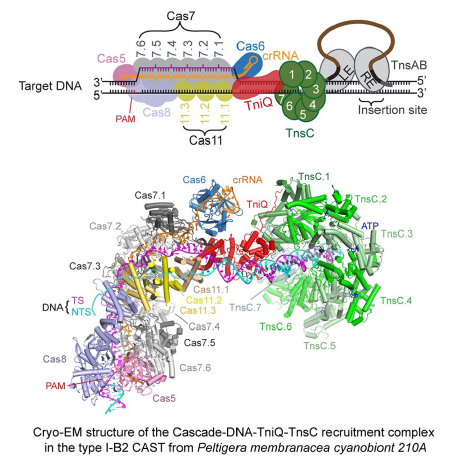
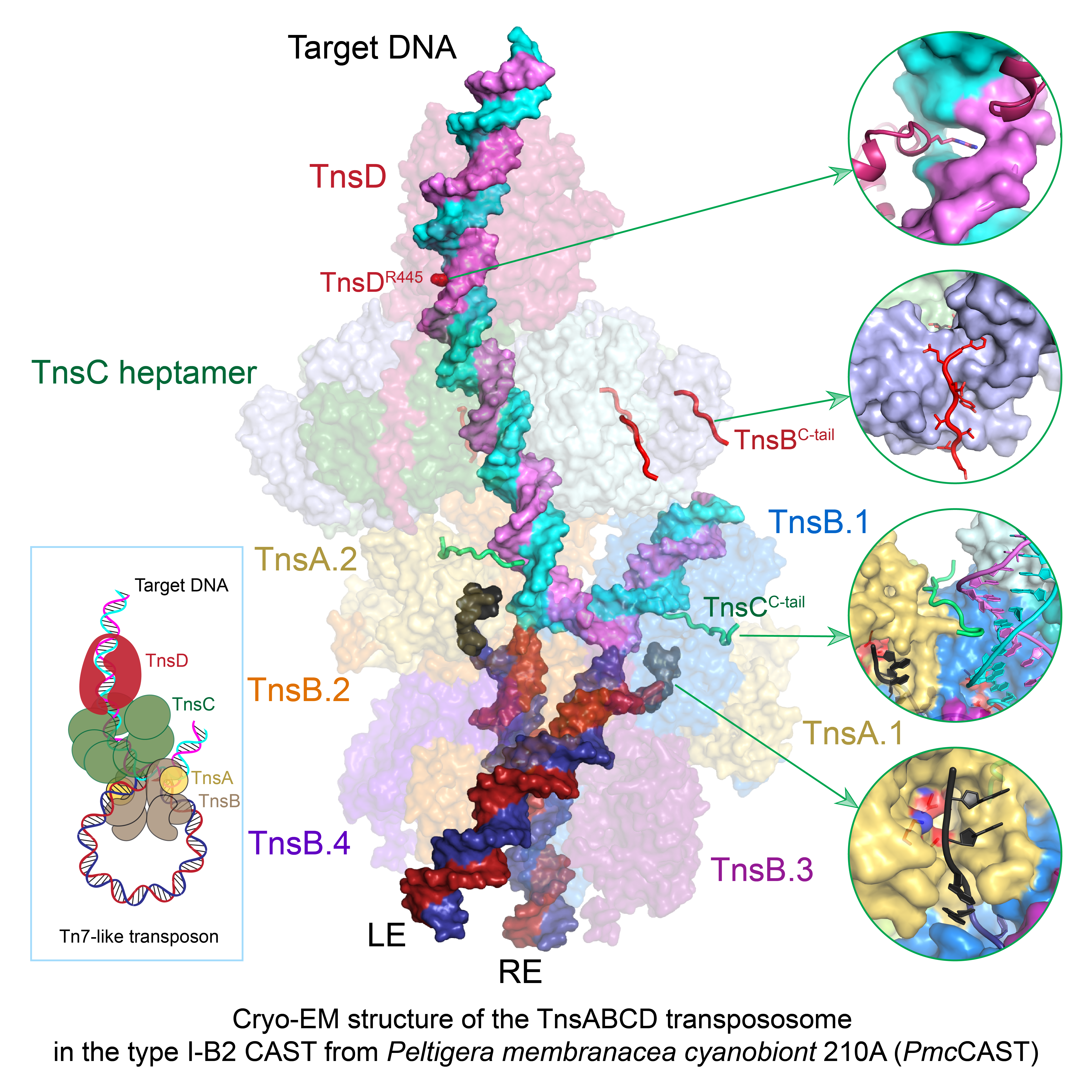
Left: Cascade–DNA–TniQ–TnsC recruitment complex (Wang et al., Cell, 2023). Right: TnsD-guided TnsABCD transpososome (Wang et al., Cell, 2024).
RNA-guided transcription
We study natural RNA-guided mechanisms of transcriptional control. In collaboration with the Sternberg laboratory, we determined how a nuclease-inactive Cas12f protein, a sigma factor, and RNA polymerase assemble on DNA to activate transcription. This work explains how an RNA-guided complex recruits the bacterial transcription machinery.
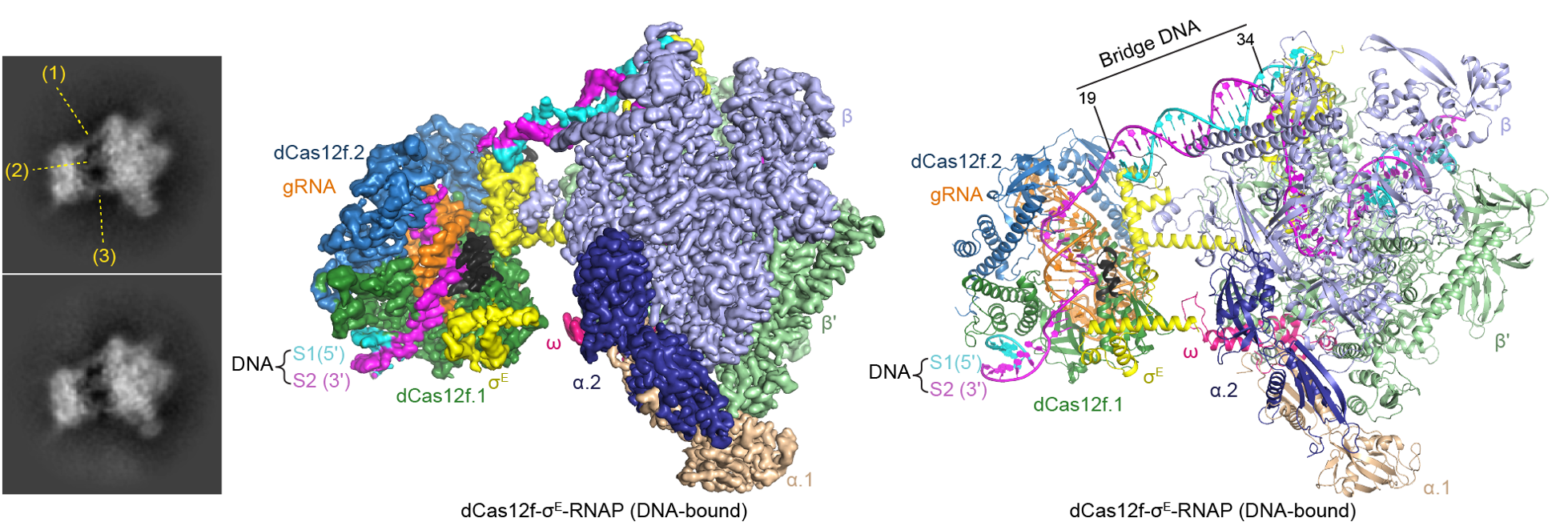
Cryo-EM images, density map, and atomic model of the DNA-bound dCas12f-σE-RNAP complex (Xiao et al., Nature, 2026).
CRISPR-Cas mechanisms and regulation
Our work on CRISPR-Cas effectors and related RNA-guided proteins examines how they recognize nucleic acid targets and control cleavage. We also study how anti-CRISPR proteins block these activities. By resolving the structures of these complexes and testing their functions, we identify the molecular interactions and conformational changes that govern their activity.